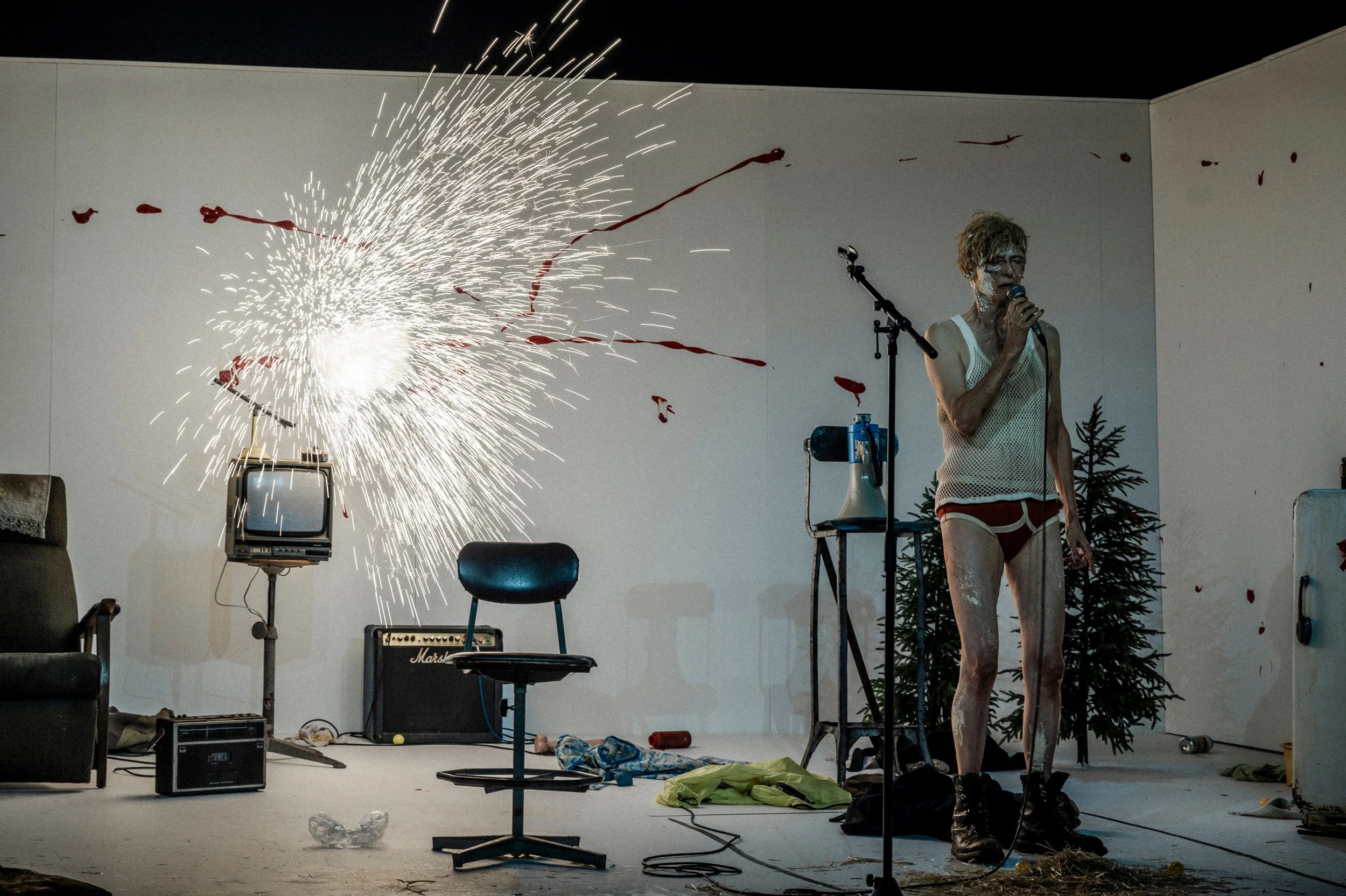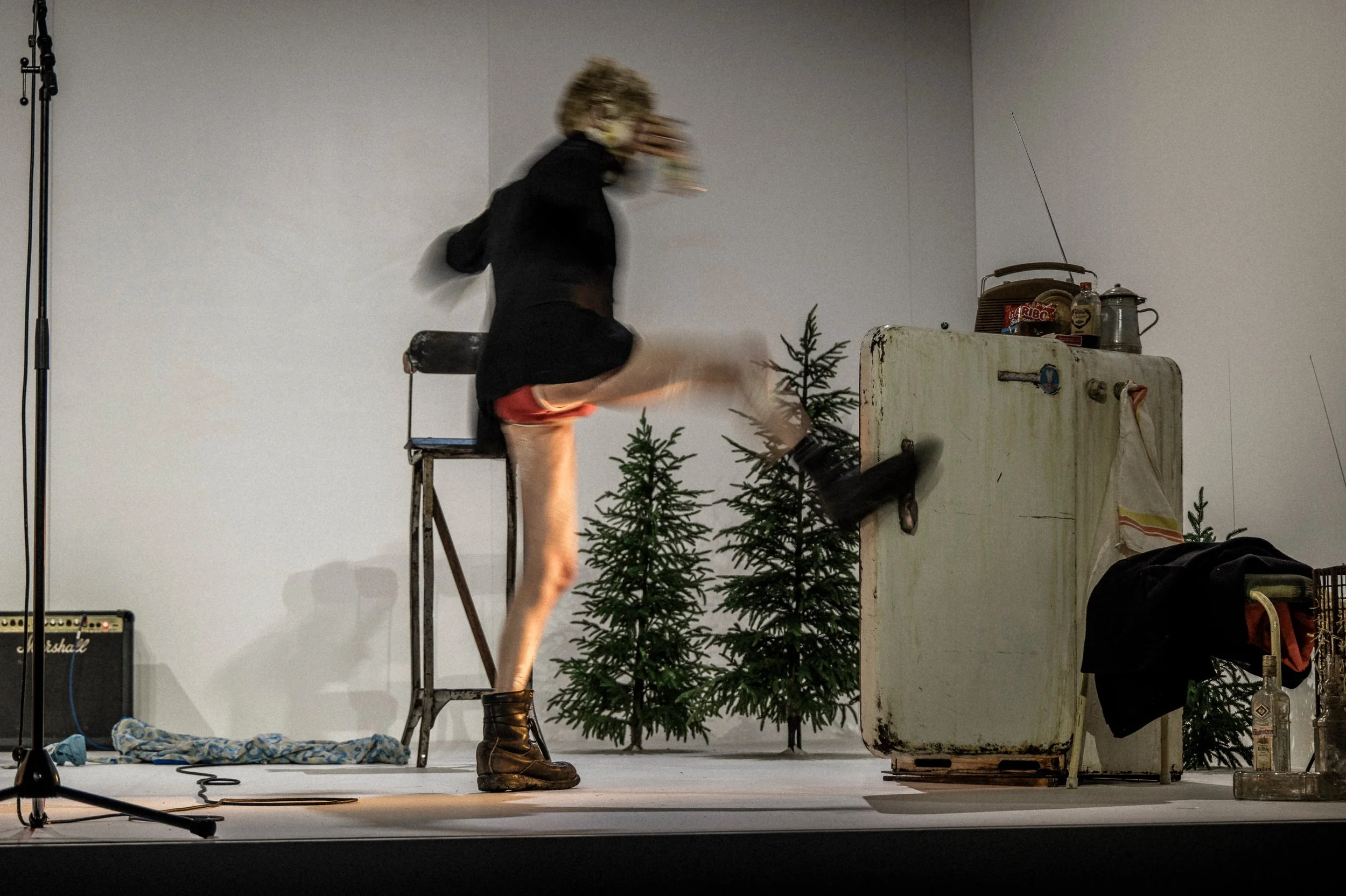
It was Pierre Audi, the much-mourned founder of the Almeida, who, way back in 1986, sent me a coffee-stained copy of Manfred Karge’s one-woman play, Jacke wie Hose. My German was just about good enough to realise that this was something that had to be seen, and soon Jenny Killick, the visionary Artistic Director of the Traverse in Edinburgh, commissioned a translation from Anthony Vivis and had the guts to give the go-ahead for what we called Man to Man.
Tilda Swinton and I were close friends from Cambridge, and we’d often worked together, both at university and in the real world, and she was the obvious choice to play the part. Along with the designer Bunny Christie and the lighting designer Ben Ormerod, we soon had a team, all in our twenties, all just starting out, all making it up as we went along. But our scratch production became a cause célèbre at the 1987 Edinburgh Festival, and transferred to the Royal Court for a three-week run the following year. In a theatre culture devoted to poetic naturalism, it surprised and challenged audiences. And it shaped us all.
Even then, Manfred Karge was a legendary figure. Born in poverty in Brandenburg before the war, his talent was spotted in 1961 by the great Helene Weigel (Bertolt Brecht’s wife, who had co-founded the Berliner Ensemble after the war, and ran it following his death) and she quickly engaged Karge as an actor. He also became a director, working in many of the leading German-speaking theatres. He wrote his first play Jacke wie Hose, which he staged with his partner, Lore Brunner, in Bochum in 1982. He returned to Berlin in 1993, where he still writes, directs and teaches.
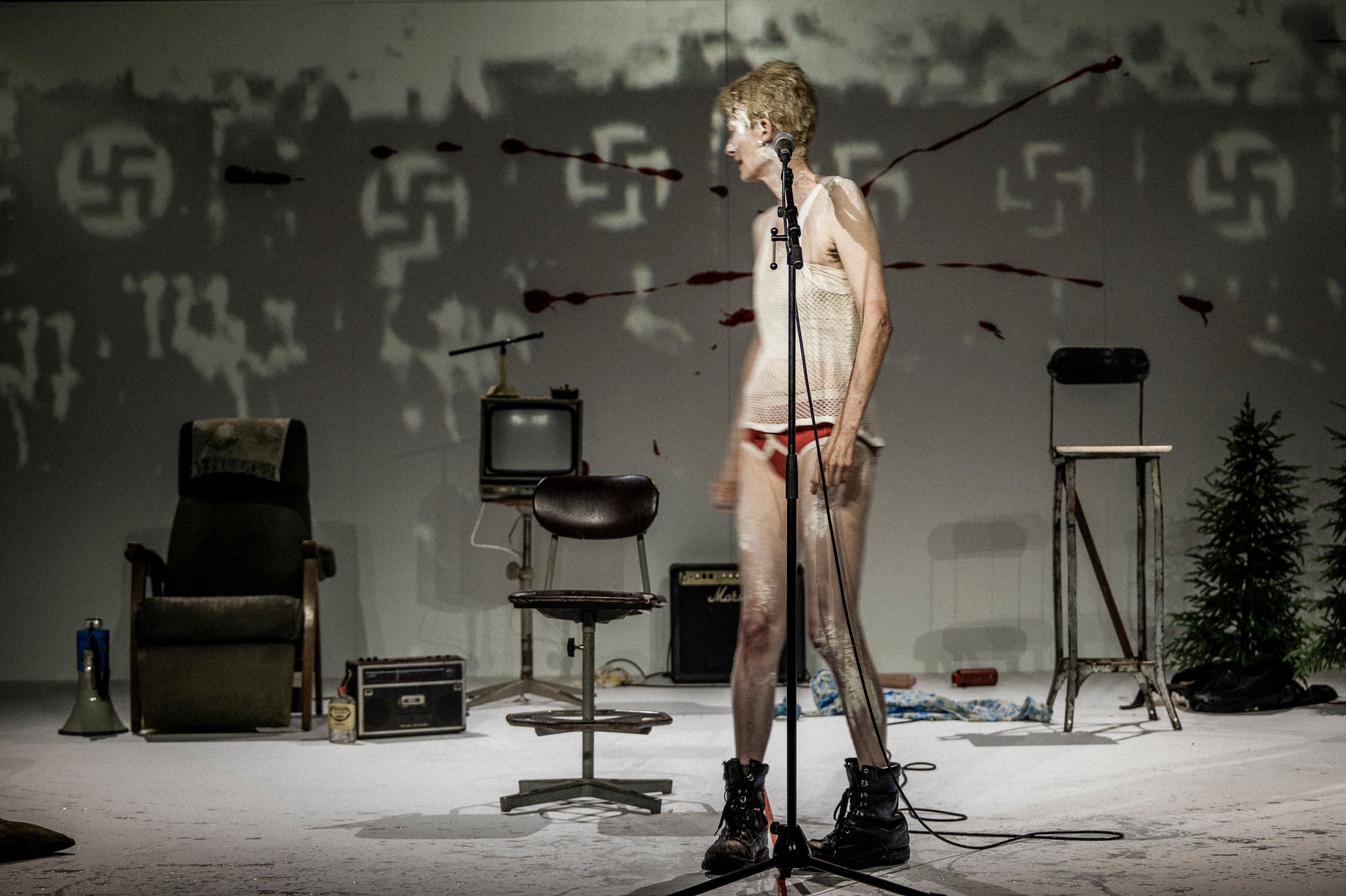
Karge’s play is a study of female survival in a terrifying world. Ella is a working-class woman who takes on the identity of her dead husband, Max, to endure what Brecht memorably dubbed ‘the dark times’: the twelve years (1933-45) of Nazi rule. But Karge extends this to include the division of Germany into two nation states (one communist, one capitalist) and the reconstruction that followed.
Manfred Karge is one of the last surviving links to the original Brecht theatre. And in true Brechtian spirit, he has written a deliberately conflicted figure: likeable one moment, repellent the next; insightful and blinkered; reactionary and visionary; but throughout, a woman from the lowest rung of society, caught up in the disastrous contradictions of her time.
Thus, Man to Man shows a divided person in a divided culture in a divided land. It explores the deepest forms of alienation — social and political, sexual and psychological — in which identities are fluid and, as Marx said, all that is solid melts into air. And in Karge’s two new scenes (one written specifically for this revival), we see the fall of the Berlin Wall and the re-emergence of the German far right, and how these divisions continue to multiply.
Man to Man is an extraordinary text. Its 28 short scenes deploy a heady cocktail of verse and prose, doggerel and naturalistic chatter, as well as fragments of songs, poems and quotations from both ‘high’ and ‘low’ culture. It is idiomatic and peculiarly hard to translate: the title, literally, means ‘trousers like jackets’, the equivalent, perhaps, of ‘six-of-one, half-a-dozen-of-the-other’. We’re delighted to be returning to the late Anthony Vivis’ stunning English version, to which I’ve made some minor revisions and translated the two new scenes.
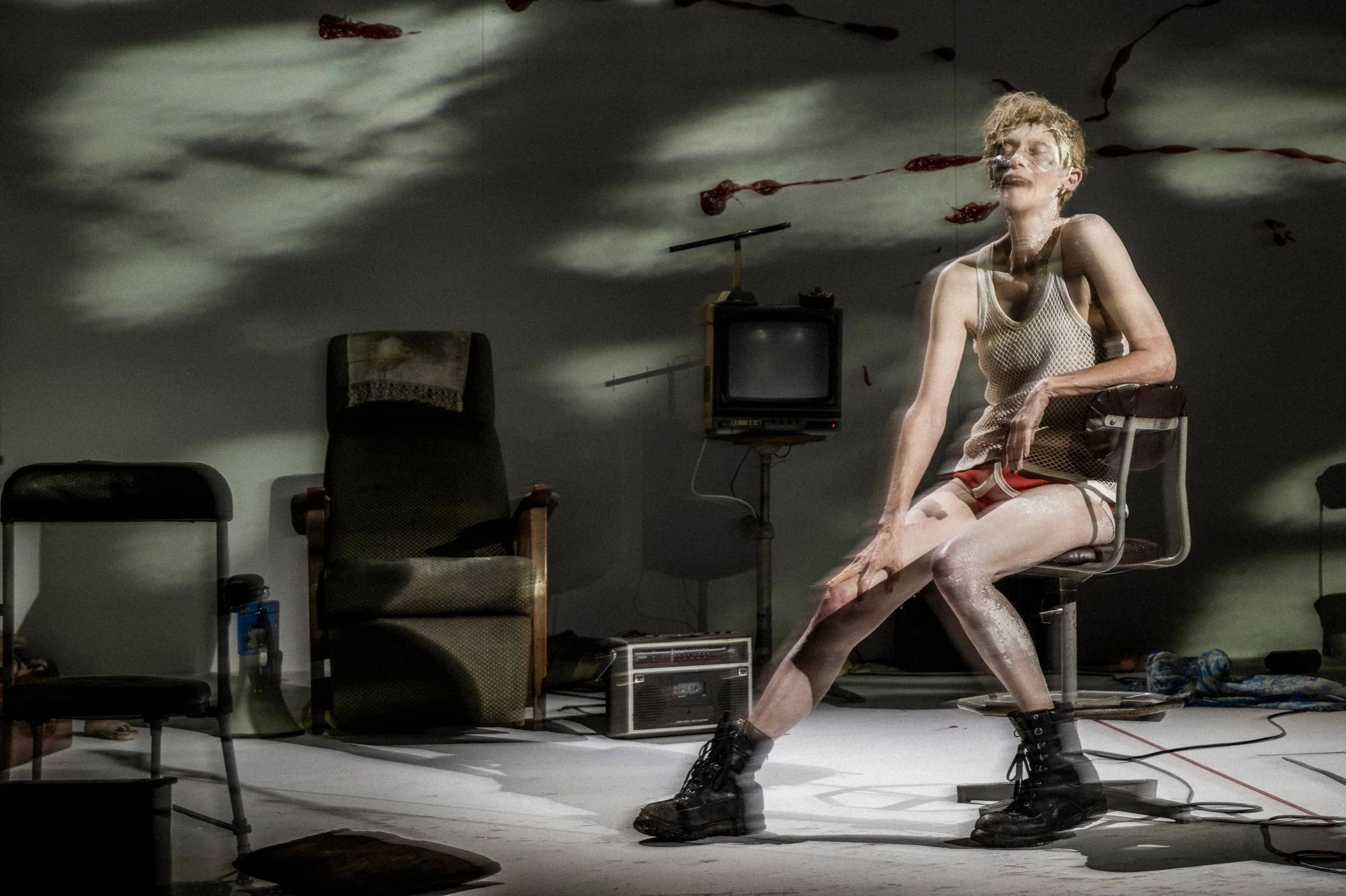
Karge’s text provides no stage directions, no sense of how he wants it to be presented, and every creative team must come up with their own answers. Revisiting the play after all these years, Tilda, Bunny, Ben and I are eager to do two things at once: celebrate what worked in our original production, while testing those responses against new realities, new ways of making theatre. Happily, we’re joined by younger collaborators, ready to challenge us, primed to contribute, and determined to make this much more than a revival from the distant past.
Sometimes, we’ve found, history overtakes us. Thus, in 1987 I suggested to Bunny that a thin line of red tape bisecting the white floor could suggest the division of Germany and the Berlin Wall, which I had recently crossed. And now, nearly 40 years later, we are confronted with a new scene in which the Wall comes tumbling down: Tilda ripping up that red tape from off the floor will be one of those rare moments when the practical nature of the theatre will act out history itself.
The theatre must live in the present tense. But it also has a past. And a future. The wheel has come full circle. We are here.