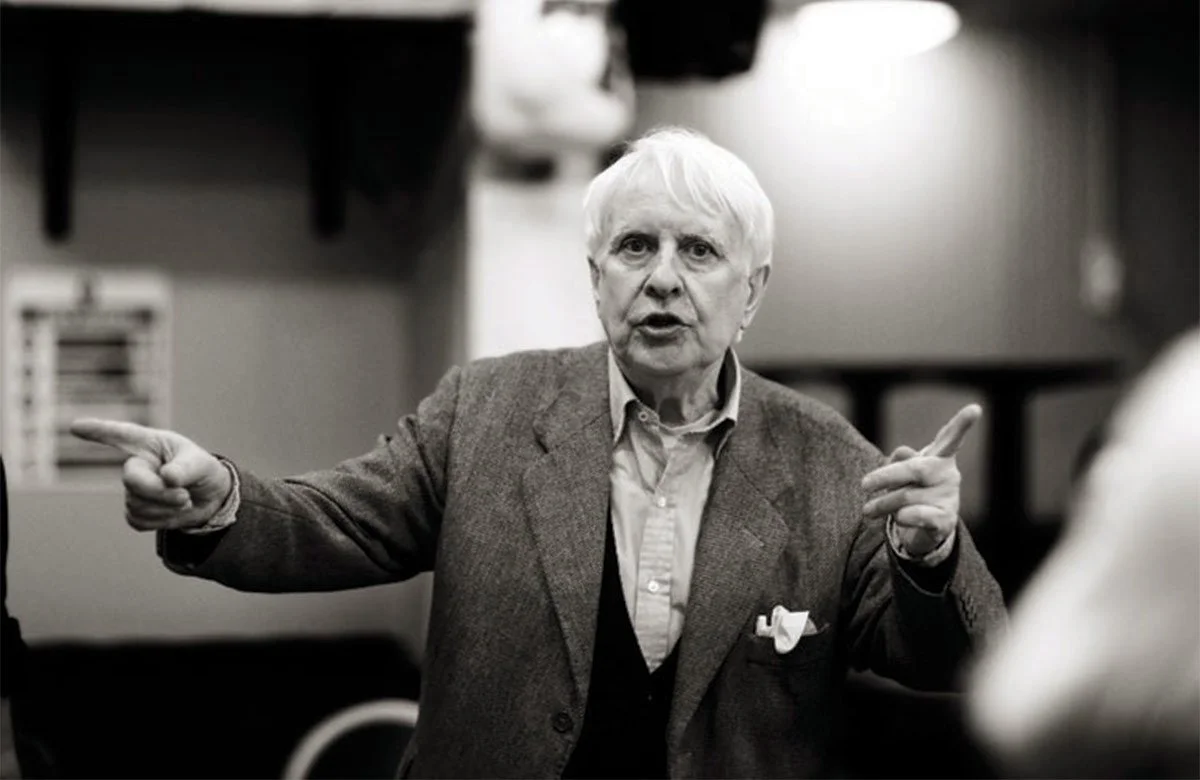
With the death of my mentor and friend Peter Gill, we have lost one of the last links to the golden age of George Devine’s Royal Court Theatre.
Peter was the most charismatic of theatre directors. With his shock of brilliant white hair, piercing eyes and stylish dress sense, he was as appealing a figure in his 80s as the young man in a black fedora I first met in the foyer of the Riverside Studios in the late 1970s.
Unlike many of his contemporaries, the working-class Gill never went to university. In his first job, he and his fellow Welshman, Anthony Hopkins, were ASMs on an Arts Council tour of Look Back in Anger and She Stoops to Conquer. He then worked as an actor at the RSC, where he played Silvius to Vanessa Redgrave’s Rosalind in As You Like It, and was in Bill Gaskill’s production of The Caucasian Chalk Circle, an experience he brilliantly anatomised in his book Apprenticeship.
Deciding to become a director, Peter cut his teeth at the Royal Court (or ‘the Court theatre’ as he always called it) in the 1960s, where he directed definitive productions of the three great plays of DH Lawrence, among many others. He was the youngest of an extraordinary generation of fine directors and, with The Sleepers Denin 1966, and Over Gardens Out three years later, became a promising playwright.
In 1976, Peter became the first artistic director of the Riverside Studios, where he directed five remarkable productions of classical plays – by Shakespeare, Middleton and Chekhov – as well as hosting groundbreaking international seasons: he was the first to present the work of the Polish auteur director Tadeusz Kantor and gave house room to the band that became the Sex Pistols. It was a very special time, and for a few short years the Riverside was the most significant theatre in London. I certainly saw everything there that I could.
Peter joined the National Theatre as associate director in 1980, where he developed his own inimitable aesthetic, perhaps best described as an intensely poetic kind of figurative realism. Often staged with simplicity and brilliant clarity, his productions paid scrupulous attention to class, status and gender, while also bringing out the innate poetry of the piece – be it verbal, visual or theatrical – in the most luminous way imaginable. There was a rigorous classicism in his work, but the result was fresh, sensual and alive. And while it was always strikingly designed (often by Alison Chitty), at its heart was a (lapsed) Catholic’s celebration of the human form.
But it’s Peter’s own plays that, to my mind, mark out his greatest contribution. Some are concerned with his own working-class upbringing in Cardiff: Small Change in 1976, Kick for Touch in 1983 and Cardiff East 14 years later. Others are set against the background of historical events: 2002’s Original Sin and, in 2014, Versailles. Still others are meditations on being gay in the modern world: Certain Young Men and The York Realist on either side of the Millennium.
What links them is the quality of attention: these subtle, acutely observed studies of everyday life show men and women connected to each other by family, work and community, but who are also often strikingly alone. Especially in his signature productions, they’re quietly gripping and surprisingly stirring plays that have lasting appeal.
Having started out as an actor, Peter had real insight into what makes actors tick, and although his perfectionism – especially about phrasing – could infuriate, he commanded ferocious loyalty from scores of our best actors, many of whom he encouraged at an early stage in their careers. Although he directed many stars, most of his work was dependent on a committed ensemble all working to one goal. He was devoted to the central importance of casting and his productions overflowed with the lifeblood of the British theatre: alarmingly present, sometimes idiosyncratic, but always vivid, tangible and alive.
I got to know Peter in the early 1980s when he opened the National Theatre Studio. Spending time there with him and his associate, the late John Burgess, was the most intense learning experience of my professional life. He showed me how to look and listen, not just study the text I was directing; how to notice what was unfolding in front of me, not what I had imagined in my head. I learned how class and status ran through the best drama and could be precisely embodied. I observed the way Peter would arrange figures in space, with each gesture and attitude imprinting itself on the retina like an Italian Renaissance painting. And I came to see that character emerges not just through what is said, but how it is said: in other words, that phrasing is fundamental.
Peter offered me, and others like me, something else too: an education in thinking. I had come up through the traditional Oxbridge route and he subjected me to a fair amount of joshing, especially for my (temporary) admiration for the European Konzepttheater: the irony, of course, was that Peter was extraordinarily well read and, for all his suspicion of the abstractions of the French and German theatre, was a true internationalist.
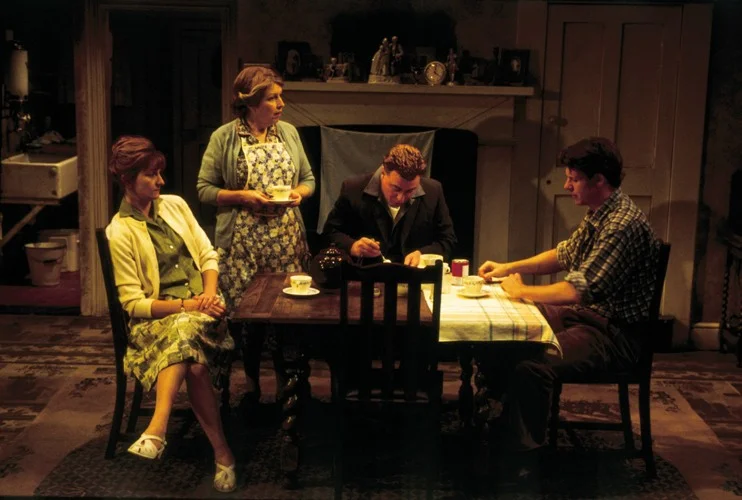
But his real point, I realise now, was that in my eager embrace of new forms, I was underestimating the existence of a remarkable native theatre culture. His masterpiece, The York Realist (which I’m proud to have produced at English Touring Theatre, and which we then took to the Royal Court) is, among other things, a meditation on the enduring power of the English popular tradition – with all its pragmatism, humanity and subversive questioning of authority.
Many of the things Peter stood for are out of fashion today. Above all, he was a proud anti-conceptual realist with an unflinching commitment to the text. But as a child of the 1960s he was au fait with all the fads of designer theatre and was no nostalgic conservative. He could be contrary, sometimes infuriatingly so, but he was staggeringly well informed and all too often in the right.
Peter’s legacy should, perhaps, remind us that a theatre that tells stories about human beings in all their complexity and contradiction is one that is most likely to resonate in the hearts and minds of its audience.
He taught me more about directing – and playwriting – than anyone else.
RIP
An earlier version of this piece appeared in The Stage to mark Peter’s 80th birthday.
